Abdelraheem Hamad is one of the ‘Gaza 40’ students, who were evacuated by the British government to take up scholarships to study in universities here. He tells Ivana Domozetska his story.
‘I just see unwanted images and incidents and it’s too difficult cope with this trauma and keep up with my studies.’
Abedelraheem’s resilience can be felt just by sitting with him. After surviving two years of relentless Israeli attack that has been described as hell on earth, nothing can stop him now from telling the story of how he escaped Gaza.
When he submitted his application to the University of Portsmouth, Abedelraheem, 38, was living in a tent. ‘I had to walk two or three kilometres to charge my laptop, and it was a risky place because many people sitting in the street or in a café were being targeted by the Israelis. I had to do apply because I needed it.’
The students were the first Palestinians to come to this country since the genocide began in October 2023. The opportunity was provided by UK universities including Cambridge, Durham and Portsmouth via the Chevening scholarship, an international scholarship funded by the British Foreign, Commonwealth and Development Office (FCDO). Nora Parr, an academic at the University of Birmingham was one of many who lobbied to get the students here.
She said, ‘Those with connections to government used them to get the ear of ministers and whispering to get the right support. Everybody was pushing to get their students on campus.’ Some MPs with universities in their constituencies helped to create networks to assist the Gaza 40. Evacuations from Gaza to Ireland had been successful in May so a route from the Middle East to Europe had been established in time for those students bound for the UK.
The process took months and was a collective grassroots campaign – nearly 40 universities offered scholarships but not every Gazan was in a position to accept. Parr described how the evacuation criteria was changed, many students deciding either to come on their own or defer the offer because they weren’t allowed to bring dependents with them.
‘This was devastating,’ said Parr. ‘You can’t ask a mother to choose between her education and her children.’
Students needed to be evacuated to another country to obtain a biometrics deferral that would make them eligible for a visa. Academics arranged legal support for the scholars because the visa centre in Gaza had been closed.
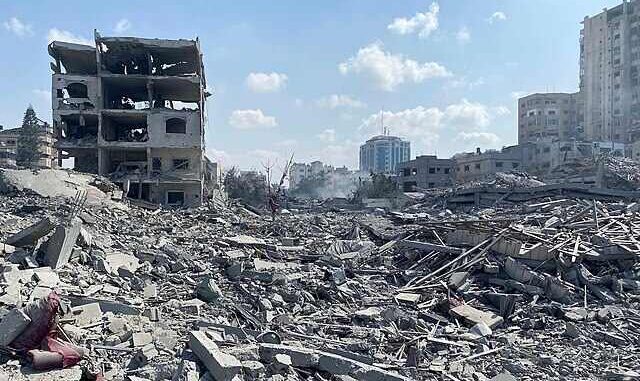
For students like Abedelraheem, leaving was a matter of life and death. According to a report by the Independent International Commission of Inquiry (COI), 90% of schools and universities in Gaza have been destroyed. As of June 2025, the Palestinian Ministry of Education has claimed that at least 16,607 students have been killed and 26,271 wounded. This has been labelled ‘scholasticide’: the destruction of education.
A safe pathway was opened after activists, students and academics lobbied the UK government for months. Abdelraheem was evacuated from Gaza from the Keren Shalom checkpoint in Jerusalem. He embarked on a 22-hour bus journey to Jordan, his only possessions his phone, a plastic bag, a form of identification and the clothes on his back.
‘Moving from a place like Gaza to a peaceful atmosphere was like a miracle or a dream,’ said Abedelraheem. Portsmouth pleasantly reminded him Gaza, which is also a coastal town.
Dr Tom Sykes of the University of Portsmouth helped to create a support network for Abedelraheem and has helped to settle him into his new life. He also was one of the few journalists to report on the Gaza 40 scheme for Private Eye magazine. He said, ‘Abedelraheem is very morally strong and it’s admirable. Nobody wants to leave their family behind, but Abedel is so committed to making his homeland better.”
Abedelraheem is pursuing a master’s degree in crisis and disaster management. ‘We succeeded in coming here but our minds are still there,’ he says of the Gaza 40. ‘Even with this ceasefire we feel so stressed about our families. It was hard for every Gazan citizen to leave their loved ones.’
His family are originally from west Gaza but haven’t been able to return home for two years due to continuous displacement since October 2023. Abedelraheem described entire families forced to move to overcrowded areas with no water and facilities. Most recently his family was evacuated to the south. While there is officially a ceasefire, Israel has already repeatedly broken it. The last air strike occurred only 15 metres from where his family were.
‘When I called, they were crying and screaming,’ said Abedelraheem. ‘They told me it’s like an earthquake hit the earth.’ He feels a certain guilt burden of guilt now that he is safe from the conflict but his relatives are not.
Abedelraheem has had an accomplished career. He attained his bachelor’s degree in architecture from the Islamic University of Gaza, which has since been destroyed by Israeli bombardment. After graduating he worked for many years with several NGOs, UN organisations and the International Red Cross where his focus was on helping vulnerable people and addressing hunger.
‘I worked in the front lines in Gaza and there is a severe humanitarian crisis. We need to have a quick response and there is an urgent need to help people there, there is no water there is no food. Thousands of children are starving.’
While Abedelraheem remains traumatised, he wants to study hard in the UK and, like other Gaza 40 students, wants to go home one day and use his skills to rebuild his hometown.
‘My message to Gazans is don’t lose your hope, the coming days will be more peaceful. Let’s work together to rebuild our Gaza.’
Image by WAFA reproduced under a Creative Commons licence.