
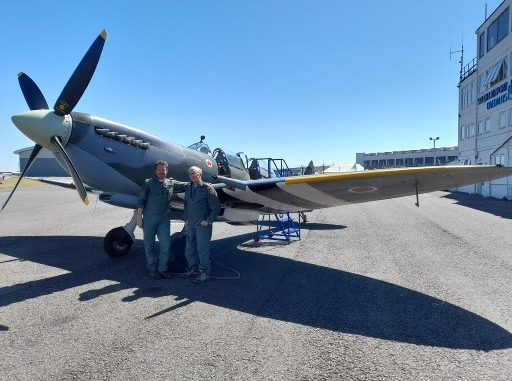
Travel writer and planetary modeller David Angus has just realised a lifelong dream: to fly a Spitfire. This is the story of that trip.
It was a dual controlled Spitfire. The real pilot in the front cockpit was young and we were on the far side of the Isle of Wight. He told me that the controls were all mine; not that he couldn’t cut in if I was doing something he didn’t want. After all I’d had zero flying experience. I forget what I said in reply. After a while thinking ‘What do I do now?’ I decided to follow the coast of the Isle of Wight.
I’d wanted to see the region I lived in from above and recently I’d gained a pension pot so I had enough to afford to do it in style. In a Spitfire. A few months earlier I’d started reading Spitfire Aces, a book I inherited maybe from my mother who was in the WAF during the war. That is until I reached a photo of a Spitfire instrument panel. ‘Could come in handy,’ I thought, committing much of it to memory over the remaining time before the flight. And now I was flying a Spitfire, it was handy.
Come the day I turned up at the airfield near Lee on Solent in plenty of time. Later a friend, Richard, arrived and had a phone camera which would provide a record of this. There was a cafeteria and large room next to the airfield with people involved in the enterprise in it.
‘I think reality is setting in,’ I said, raising a chuckle with my remark as the Spitfire I was to fly in taxied to a halt outside the window. Two cockpits and I was to go in the rear one. An old fellow got me into my uniform complete with helmet and fitted microphone for communication.
He got me into a parachute harness as well and took me through the survival test, including jumping out of the plane with a parachute, which I passed, having done enough ‘homework’. By that time I was in the cockpit; a very tight place with no floor, just machinery and the aircraft fuselage, but the instrument panel and control stick were recognisable from that photo in the book. Just as well, for this environment was like nothing I’d experienced before. The whole thing was potentially hairy. And in front of me on the cockpit cover was a video camera to record it all.
And that was the thrill of it. Triumphing over my nerves through the go-ahead, the taxi past the cafeteria, the final wave to Richard and the positioning at the end of the runway, then the final run to take-off.
The elation of it! My spirit rose as the plane left the ground and gained in altitude, though I could hardly believe it. The realisation that, despite the abysmal times I had gone through as part of life, I was succeeding in doing this in a historic aircraft that was an icon of an epic battle against the odds. And I was succeeding in my battle against the odds that had been against me.
The views were breathtaking under the brilliant blue skies. I just had time to take in the roads below where I travelled every day to and from the school where I work. I had no time to see the school itself before we were heading south past the estate where I live. Then we were over the Solent before turning to follow the north coast of the Isle of Wight towards the Needles. There was so much to look at, to take in. I’d been told to look out for any approaching aircraft and discussed whether I should warn the pilot with directions like ‘2 o’ clock high’, like they did during the war, but saw nothing. What must the danger of mid-air collisions have been like during the Battle of Britain, I wondered.
‘I can see the bottom of the sea!’ I exclaimed. I didn’t realise at the time that it was a shallow part of the Solent near Ryde.
Then along the coast past the estuary at Cowes we struck into the middle of the Isle of Wight and eventually the Needles. Its chalk spikes were so small against the immensity of the Channel and everything else I could see. A tiny part of this planet as a whole.
Then along the island’s south west coast and the point where I took over. From there I must have flown around about half the island and up to Portsmouth; gently tilting the controls and being right about feeling it to be a very responsive aircraft, following the coast while keeping the eye on the horizon and altitude dials so we didn’t deviate too much from the horizontal and 2,000 feet, more or less our height. The pilot complimented me on well-controlled turns.
An exception was the victory roll. I’d been mad enough to ask if I could do it just for the hell of it and was of course politely refused. Just as well. I had a concern about throwing up in the cockpit and had had a light breakfast as a result. I’d seen that situation on a film; very funny then but the ultimate disgrace now, especially since it would go everywhere since there was no floor. Anyway we headed inland then the aircraft was thrown forward and into it before I could find the sick bag in my overall I’d been issued with, so I shut my eyes through some of it but glimpsed the world corkscrewing around into a wall then vertically above then back to normal. And I’d survived without throwing up to say ‘That’s enough excitement.’ I think it was probably over or near a friend’s house who complimented me on Facebook later.
After the victory roll I took over again and crossed the Solent towards Portsmouth, waiting for directions from the pilot. We were virtually on top of Portsmouth with its forest of buildings, locations of memories and friends at the University. At the last moment I was given Hayling Island and peeled off towards that.
Back down the Solent for a landing at the Lee on Solent airfield. When the plane eventually halted back where we started from, I was helped out of it by the old man again which meant close contact and a joke from me: ‘Someone into “safe spaces” and “social distancing” would have no chance here!’ Out of the aircraft I was offered a glass of water.
‘It’s not vodka?’ was my response, remembering champagne being offered after I got through the world’s biggest cave in Vietnam some years ago.
‘Everyone’s whispering,’ I then remarked, prompting laughter. My ears had been affected by pressure difference. Photos were taken of us in front of the Spitfire. I later found that the video camera had recorded everything at every angle.
Because I had been able to fly a Spitfire I was also able to reach an unbelievable conclusion: It is actually easier to fly a Spitfire than it is to deal with some computers!
I was well and truly bitten by the bug. Theme music from The Battle of Britain film kept playing through my mind into the weekend and beyond. Compliments came flooding in on Facebook and to hell with pride being a sin. The guy I worked with started calling me Douglas Bader and Biggles. To make matters even worse I came across the film itself just begun on TV while I was trying to work on a Saturday afternoon. So it was down tools, out with the beer and – with Trevor Howard, Michael Caine, Edward Fox and Ian McShane – bask in my newfound drunken glory!
But being reminded of what the RAF went through in 1940 made me realise that I’d just scratched the surface regarding flying skills. If I come into another windfall maybe I’ll go up again and take it further.
Photo courtesy of David Angus.


