
A few weeks ago a gathering of 7 friends, 2 children and Queen Victoria travelled in time with David Angus back to the Hadean age, over 4 billion years ago. They stopped over on the way in Rowner, Gosport and Portsmouth.
The time machine was a terrapin hut in Gosport between Brune Park School and the cycle path. The controls and display were my laptop on a table by a big TV screen.
I’d been working for some time on this because I knew nothing about the technology when I started but by now I had the upper hand with AI visualisations, animations and audio effects, if not complete control. The rest of it I trusted to luck and now I’m back in 2026 I can testify that it went like this:
“Welcome to the Gosport Time Machine. I’m Captain Dave.” I announced, resplendent in my steampunk gear. I explained that time machine mini drones would pick up scenes nearby, some of which would be still images, some animating repeatedly due to time effects. That was my story anyway. Later I’d add that we would appear like ghosts to whoever or whatever lived in the visited time. Anyway we’ve got a long way to go time-wise so let’s get started on minimal time mode, 10 years per second.
After 8 seconds (I had it all worked out) of swirling time travel effects and suitable melodic hum we arrived at a view of blue sky and clouds. Why? Well the nearby Rowner estate where I live had been an airfield. Research had shown that it was operational when Gosport and Portsmouth became the front line against Nazi tyranny. “It’s August 1940,” I was interrupted by an air raid siren. “The Battle of Britain is about to begin!”
The siren died down but Goring’s Luftwaffe was on it’s way. “Where are they?”
Sounds of Stukas coming for the kill, then animated visuals of such. “Swarms of the sods!” Then a Spitfire appeared, followed by more swooping to the attack “Here come our brave boys!”
In all the excitement I returned to the Stukas by accident which helped create the reality of a dogfight by the time I’d got that sorted.
Only one problem: the Stuka’s fuselages still sported American air force markings despite my repeated instructing of AI to get rid of them.
Next stop was 1870, when Britain was a superpower. The time machine location was important because the cycle path then was a railway complete with station nearby. You can still see that converted into a house with the partially crumbling and overgrown platforms still there. The station also allowed a very distinguished personage to alight and join us. None other than Queen Victoria! In reality, a ward manager named Heather who was of similar build to this monarch and whose steampunk costume research was brilliant. “Your majesty, it is an honour to welcome you to our intrepid time travel adventure.” She sat across from me at the other end of the screen and gave an ornate speech.
Then there was the shortest time hop of the journey, 5 seconds to 1812. Napoleon was invading Russia and Sharpe of TV fame was likely to be active in Spain about now, but – as views of rustic countryside showed – Rowner was a mere nearby hamlet and farming community. A bell sounded. It must be Sunday and the faithful are being summoned to a sermon at St Mary’s church which actually goes further back to AD 700.
A sermon I gave about honest toil on the farm was interrupted by the sounds of a dedicated drunkard, in the den of debauchery that was Gosport then, just a few miles away. Visualised as mostly taverns, it was the same story with Portsmouth. I made the most of this contrast with a religious rant about sin and temptation; but the problem was really one of labourers led astray being all at sea the following morning. Quite literally. Press gangs were active in Gosport then and those taken would be well on their way to the Atlantic and a more adventurous life in the navy.
After that we were on the run somewhat. First from a marauding band of Royalists plundering Alverstoke and Fareham during the English Civil War and most likely Rowner in between. We could see smoke rising above the trees then the band appeared.
Next in 1349 footsteps through woodland heralded a raiding party of the French during the Hundred Years War. They raided Portsmouth so why not Gosport? The Black Death, being rampant then, added to the danger too.
Then I switched to intermediate time travel mode, for our journey now was not tens of years nor hundreds, but thousands; way back past the Norman conquest, Roman, early civilisations and Stonehenge to the last ice age.
The view 20,000 years ago was one of tundra and scattered woodland along a river valley. The ice never reached southern Hampshire but it covered the north of England so it really was ‘grim up north.’
There was no sound so the computer was throwing the kind of wobbly I hoped it wouldn’t.
Ah, sound after all: a whistling wind suitable for a tundra wasteland. No sea could be seen because sea levels dropped enormously during an ice age so the hills on the right would be the Isle of Wight and the flat faraway horizon would actually be the English Channel!
“You could just about make it on foot to France and easily get to-“ I was interrupted by impatient trumpeting. “The Isle of Wight as long as you didn’t mind a herd of Mammoth-” shown with further muttering and trumpeting. “The odd woolly Rhino,” one appeared above the river with a snort. “And maybe a sabre-toothed tiger.” One appeared with a purposeful look and throaty snarl.
More trumpeting alerted us to a Mammoth hunt inland. Our early ancestors were out and about.
After that it was serious time travel. A million years a second. The ice ages were already gone and the world was getting warmer the further back we went. I tried to fill in 2 minutes with descriptions of fantastic mammals and – beyond the Eocene thermal maximum – gigantic snakes such as Titanoboa.
“Good Lord we’ve just frightened a carnivorous dinosaur!” I declared shooting up out of my seat as a close-up of this massive enraged monster bellowed at us to the accompaniment of a roll of thunder. The little girl in our group reacted to the melodrama with her mouth open in a silent overawed ‘ohh!’ “Welcome to Lower Cretaceous Gosport.” The scene changed to our frightened dinosaur appearing to gather its wits by eyeing an armoured dinosaur in the middle distance. Beyond that, a receding thunderstorm hung over what was known as the Great Wealden Swamp, stretching from SE England across France to a prehistoric ocean. The same country could be semi arid during dry seasons with evidence of huge fires, otherwise, pterosaurs were flying above the partially wooded swamp and a pair of brachiosaurus could be seen in the far distance. By now, the sounds of more dinosaurs alerted me to a new scene of an iguanodon herd.
“Adults the size of double decker buses. Huge herds of them sweeping majestically across the trampled Cretaceous savannahs.” I waxed enthusiastic, inspired by John Cleese in Fawlty Towers. A more immediate concern was the animation of brachiosaurus lumbering towards us. Their main bodies were almost equal to the size of small Victorian terraced houses, so it was time to move.
Fossils of these dinosaurs were found on the Isle of Wight. Marine fossils too, are well known on the Jurassic Coast of Dorset. Both are close enough to Gosport for such creatures to have existed there too. The Jurassic Period, 160 million years ago, was where we were headed. Britain then was like the Bahamas; smaller islands in a shallow sea.
There were underwater sounds and scenes but I told everyone not to worry; we were waterproof. So we saw ammonites which varied from the size of coins to shells with diameters bigger than a man, the long necked plesiosaurs, an icthyosaurus looking like a big fish although it was reptile. A drone displayed a close-up of an island on the horizon where an early sauropod and pterosaur could be seen. Best of all a megalosaurus appeared. Since this was the earliest dinosaur to be discovered, it was modelled as a gigantic lizard in the Crystal Palace gardens and I wore the T shirt with that image for the benefit of the audience.
Uh oh here comes a curious pliosaur with jaws as long as a man, time to go!
Next it was Pangea, 240 million years ago in the Triassic period. 10 million years further back there’d been massive continuous eruptions in what is now Siberia. That combined with climate extremes caused by the Pangean supercontinent led to a huge mass extinction. Much of Pangea was desert and where we were looked like the Sahara. Partially because the geology of Gosport was on the same latitude of the Sahara that long ago, due to continental drift, and the images I used were photos I’d taken of the Sahara Desert anyway.
A search of rocky terrain led to lystrosaurus, pig like animals so successful they lived in all parts of Pangea, and a glimpse of a reptile smaller than a cat, found in Scotland, which might have been an ancestor of pterosaurs.
It was a journey of extremes, from a Jurassic sea to a Pangean desert to a Carboniferous coal age jungle swamp. The most recognisable plants were tree ferns and horsetails, though they were the size of birch trees and bigger. The highest plants included sigillaria shooting up like flagpoles with tufts of foliage on top and Lepidodendron which looked like a rain forest giant, except both were actually moss!
Another weird aspect of the Carboniferous 310 million years ago was increased oxygen atmosphere content because of the success of the coal age forests. That meant the bugs really were ‘bigger and better.’ Giant dragonflies, spiders the size of Halloween spiders and scorpions the size of small dogs. Amphibians too, grew to the size of alligators and could be as dangerous.
A crunching sound was added to the throbbing buzz of the swamp. Arthropleura were approaching us, their centipede like bodies as long as cars! Time to go.
Their was a brief stopover in a Silurian sea. Before any trees, plant life was evolving on land, some looking surprisingly like peculiar scrub high specimens I’d seen in the Canary Islands. In the sea one could still see coral which went back even further, Trilobites which were everywhere and a sea scorpion 15 feet long. Then…
We crossed an immense stretch of time of nearly 2 billion years at around 5 million years a second. That gave us over 6 minutes during which I half hoped the visual effects speeding us through the black starry background of space and time might hypnotise the audience so they wouldn’t get bored.
I explained anyway that we were going beyond all life on land, all advanced life anywhere, Snowball Earth where ice advanced to the equator, the Great Unconformity where no sediments were laid down and the Boring Billion where nothing much seemed to happen.
At 2,400 million years, the scene was one of ice everywhere. It was the onset of a series of Snowball Earths called the Huronian Glaciation. The sun is weaker the further back one goes in Earth’s history which might have contributed. One could see the sea was the colour of red wine because of all the iron in it caused by increasing oxygen which also diminished greenhouse gases keeping the planet warm, but there was not enough oxygen to breathe and sky had the colour of dawn or sunset, the atmosphere being different from now on.
Another billion years added up to 3.5 billion years travelled. Imagine the barren island of Lanzarote multiplied into various islands strewn around a global ocean. I used photos I’d taken of this volcanic island for this time and the Hadean. The sea was green because of micro-organisms, the lumps looking like dirty cushions, were stromatolites – still to be seen in Shark Bay, Australia – producing the first oxygen and- ‘God the Moon’s enormous! Much closer at that time. What’s that range of hills on the horizon? That no range of hills that’s a wave!’
The tides were enormous too. Time to go!
Our final destination. The Hadean. 4.1 billion years ago. The Earth itself had been formed only another 4 or 500 million years further back, so this could be as about as far as one could go and find a solid surface albeit one prone to earthquakes and volcanism. There was actually evidence of water 200 million years further back incredibly but its state was questionable since where we’d wound up still had temperatures around the boiling point of that liquid. It was more like Venus here than Earth. Explosions! The view of volcanoes and a steaming plain was animated with that and incoming stuff. ‘Oh no I forgot about the late heavy bombardment!’ Asteroids, comets, bang!
‘A near miss! Let’s get out now! Everyone okay?’ Everyone was and we relaxed into a 13 minute journey home at hyper time travel mode. Plenty of time for questions, pee break, whatever. But first, I had an agreeable surprise for Queen Victoria.
If she trusted my calculations, regarding not meeting oneself when time travelling, I could drop her off in 1850 instead of 1870 and she could be reunited with her beloved Prince Albert. A bowed head and dainty dab with a handkerchief showed she was quite overcome but she recovered in time to present me with a medal just before we arrived.
Meanwhile the young boy of the group persisted in questioning me to the embarrassment of his father but I assured him that that was what a child should be doing and I was hoping someone could fill up the lengthening amounts of time travelling with questions, particularly on the journey home.
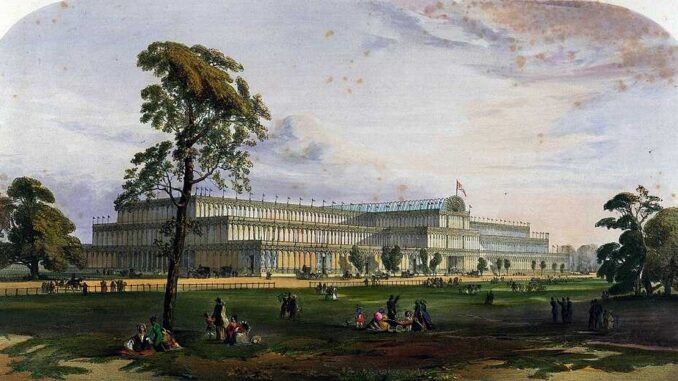
1850. I had illustrations of the Great Exhibition, Crystal Palace and Hyde Park handy to set the scene. Then it was the last stretch. A pretty minor one on low time travel mode of 17 seconds.
An image showed the cycle path as it should be but I asked someone to check outside just in case.
Picture reproduced under a public domain licence.


