
Writer and planetary modeller David Angus’ toe refused to heal after he had a nail removed, so he had to re-bandage it through Christmas. But he had a good one, as he explains here.
I was with family in Cornwall who gave me a bottle of rum and Battle of Britain DVD so I could celebrate my summer half hour of glory flying one, while under the influence. I like the time between Christmas and New Year. It’s a period of unique freedom; one relaxes and indulges in more of what one likes than usual before those New Year resolutions start. There’s more time than usual to reflect, to plan.
I’ve had a great year: becoming a Fellow of the Royal Geographical Society, flying a Spitfire and climbing the Dolomites, which proved I still could. Now I’ve gained insurance contacts from the RGS, I plan to climb ‘The Lost World’ in South America, despite being in my seventies. But this time last year I was in a bad way, with just a bottle of Jamaican rum to keep me company over Christmas. How did I manage the comeback?
My monthly column is another achievement and this article just might help those who are in a similar position to where I was last year. When the worst has happened; be it love life, financial, medical, social exclusion, cherished dream hopelessly trashed. Whatever. So this New Year’s message is about recovery from a disaster and how some of my experiences and tactics might be of use in relating to situations some people are lumbered with now.
My comeback can be broken down into three stages.
Inquiry. This is the hardest part. Like the toughest part of a journey being the first step. To hold an inquiry, a conference in one’s head as to why things went wrong and how responsible one was for that. If one is and can ascertain where one went wrong – even partially – that may help avoid similar situations in future.
But this advice should come with a government health warning. This is an inquiry, not a humiliation. One may be culpable but bear in mind you’re human, everyone makes mistakes at some time or other and there might have been good reasons for yours. Most of all if one has critics who are only interested in condemnation pay little heed. Ask yourself if they’re prepared to apply their stringent standards to their behaviour as well as yours? The answer’s usually no.
The last two paragraphs may seem like contradictory advice. The reason being that one should try for a balance between being as objective as possible about oneself but not overdoing the navel contemplating into too much guilt. Necessary though difficult. And one should have some time to grieve too but either way a time limit ought to be set on this stage so as not to sink too deeply into depression.
Counselling may help. Counselling often aims at rebuilding confidence more than fault finding and this is desirable.
Another possibility is drowning one’s sorrows with a friend who can be trusted to listen without condemning. With their help one might have one’s pain eased or even reach an illuminating conclusion or two. Just be sure to get a few rounds in for your friend, listen to them as well as holding forth, and don’t drive home afterwards.
Strengths and weaknesses. You’ve had the hardest part, now for the easiest bit. Think of anything that makes you feel good. Any kind of achievement, hobby, great holiday, friends that are still friends, even simple things: favourite colour, song, scene, sunlight on foliage. Whatever. I found this advice in New Scientist some time ago from a child who wrote this down, cut the desirable descriptions into strips of paper and put them into a jam jar to fish out random reminders about how good life could be when one felt sad. Something easily lost sight of. Trust me, it works!
Try extending this into listing ones achievements. Don’t say what achievements? Think of a minor one or two to start with if nothing comes to mind. The more one thinks about this and writes it down the more one may remember. And achievements come in all shapes and sizes. I’ve had ones as varied as saving a friend’s life, a simulated docking with the International Space Station, winning a pub quiz single handedly or just keeping a valued friend.
The purpose of this stage is to ascertain what one’s good at or potentially good at and also what may count against one or is best avoided. Think about what one was good at or not at school, any success or failure, feats of strength and endurance, even a sense of humour.
Don’t underestimate humour including black humour. There’ll be bouts of depression as one climbs out of one’s hole for months ahead and if one can find humour it can be the best medicine.
Counselling might help again, or another pub session with that trusted friend to discuss this stage generally.
Plan and Action. First of all, plan an achievement well away from the disaster zone. Any attempt to improve things there at this time is likely to drag one down further and that whole situation should be avoided, ones mind being better employed elsewhere.
It helps if positive thinking leading to action is based on ability, however limited. This is where your strengths and weaknesses form the foundation for a plan. One example of this was working out my chances of getting through the world’s biggest cave. This can be the method for any of your plans regardless of how unambitious. Anyway, I found that cave on the internet because I love travelling to natural wonders, (love = interest = strength) but could I go there? I had the money (strength) but I was in my mid sixties (weakness) and on blood pressure tablets. (weakness) But I was still in good health. (which tended to counter age) The cave was in Vietnam so one had to endure a tropical climate, (weakness) but the year before I’d hiked in 4 hot countries, (strength x 4) none were long hikes, (weakness x 4) but 4 were up steep inclines (strength x 4) and one was up a jungle river. (strength) More strengths than weaknesses seemed to justify an attempt, then I was accepted for the expedition! Then I put myself into my own army to get into shape! I was punching above my weight but if one gets somewhere based on some sort of fact one can work hard building on that to achieve a fantastic adventure.
There’s no doubt that money helps since the cave was an expensive enterprise but when without money I managed to hike from Gosport to Reading by staying with friends. Then there’s crowdfunding for sponsored hikes although I haven’t tried this. I recommend ‘thinking outside the box’ anyway.
And speaking of that, once in awhile one might encounter something outside one’s experience. Provided there isn’t much to lose through failure, my contradictory advice again is go for it. I’ve had at least 2 such experiences: creating a successful carnival sea monster and becoming the highest scorer at a bar skittles event despite no previous experience in either case.
It all helps raise morale which is badly needed. In fact – though having some basis in ability usually helps and any success is better than none – the more audacious, groundbreaking or even outrageous (to your critics) your action is the better. There’s a pop song ”Search For the Hero Inside Yourself” which is perfect advice here. Think of novels and films about heroes, such as ‘Gladiator’. How inspirational someone is whose response to an irretrievable disaster is to become a hero, often through success elsewhere. Without killing anyone or joining a war aim for a safer version of inspiring yourself and others.
One might have to struggle with fear or failure. Keep watching heroic films and turn to anger, actually. You’ve likely had plenty of anger when things went so wrong. It can be a dangerous emotion, a kind of emotional plutonium, but it can be harnessed to give one the determination to keep going and eventually put that bastard Fate into the Half or Full Nelson it deserves!
Eventually one can look at the original disaster from a fresh angle through this indirect strategy; reducing the pain of it or maybe even opening up a way to begin doing something about it when armed with the confidence gained by ones endeavours. There is absolutely no guarantee here but an attempt I tried at this stage that made a friend nervous met with more success than I thought possible.
Good luck. Have a Happy and Heroic New Year.
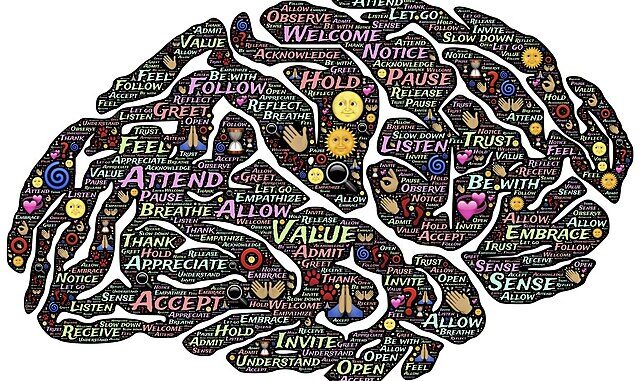
Picture ‘Mindfulness Brain’ reproduced under a Creative Commons Zero, Public Domain Dedication licence.


